


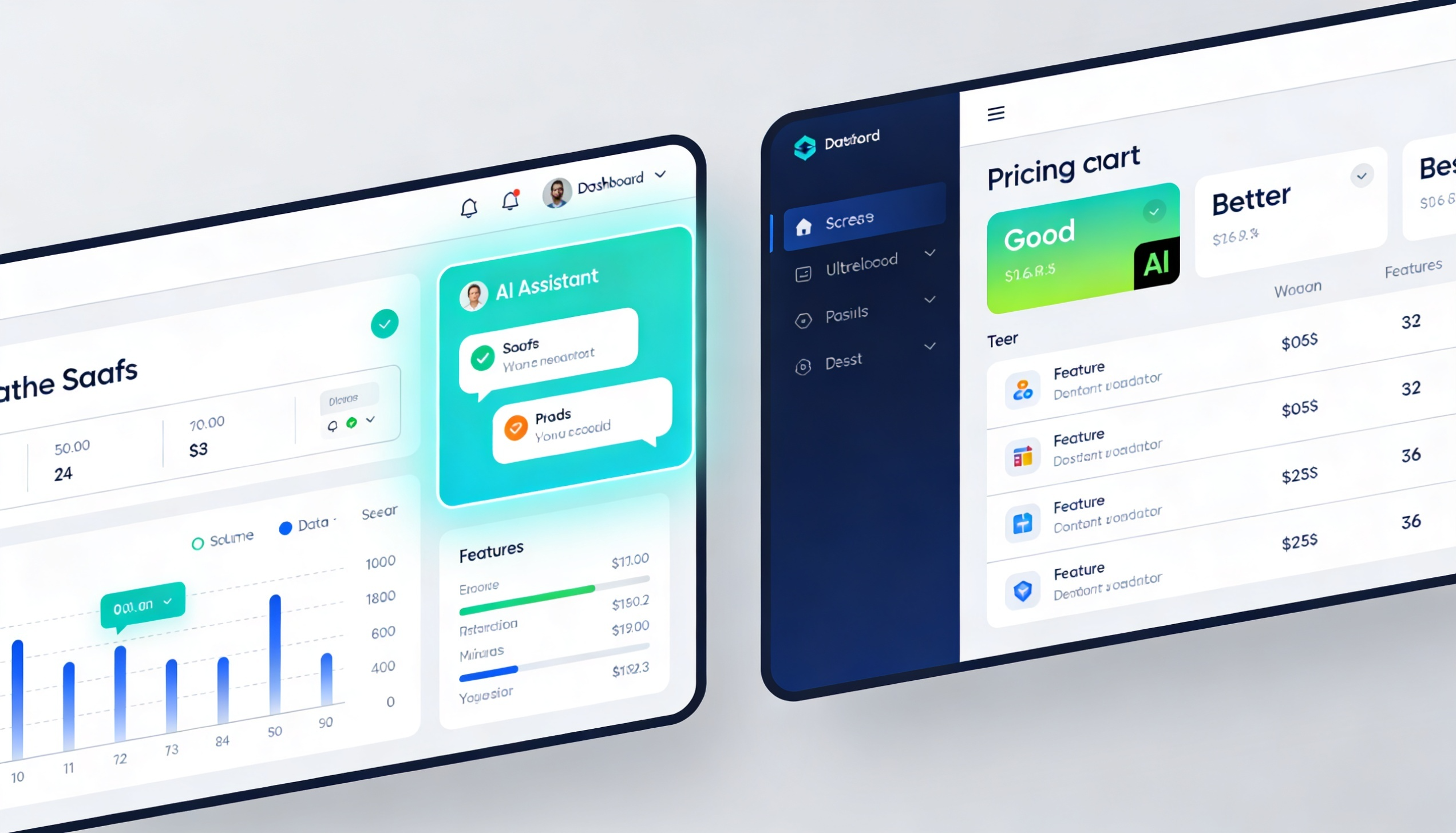
AI has given SaaS companies a real chance to grow faster, improve margins, and make their products more useful in everyday workflows. This is why so many teams moved quickly to launch copilots, assistants, automations, and agents over the past year.
But speed has created a different problem; many companies are rushing AI into their products before they figure out how it should be sold:
- Some add it into existing plans and blur the value of their core offer;
- Some give it away too early and train customers to expect more for the same price;
- Others build pricing pages around credits, add-ons, and premium tiers that make perfect sense internally and almost no sense at all to the buyer.
This tension is now increasingly present across the market.
By early 2026, more than $1 trillion in SaaS market cap had been wiped out as investors question how AI will affect traditional software models, especially those tied to per-seat pricing.
At the same time, pricing across SaaS has been shifting as vendors respond to rising compute costs, changing usage patterns, and stronger pressure to connect price more closely to delivered value.
This is where the real challenge begins. Adding AI to the product is only the first step. Packaging it in a way customers understand that value, and want to pay for it is where the harder work starts.
Read on below on how SaaS companies can sell AI features without weakening the product that made customers trust them in the first place.
The Cannibalization Trap and Why So Many SaaS Companies Fall Into It
This is what cannibalization looks like in SaaS:
- A new AI feature, add-on, or tier starts pulling customers away from a stronger offer instead of moving them toward one;
- The business launches something new expecting expansion, only to find that the pricing has made the existing product harder to justify.
This happens more often than many teams expect, because in 2026 AI feels urgent. It’s so easy to focus on shipping the feature and assume pricing can be adjusted later. But once customers see AI in a certain way, that perception becomes harder to undo.
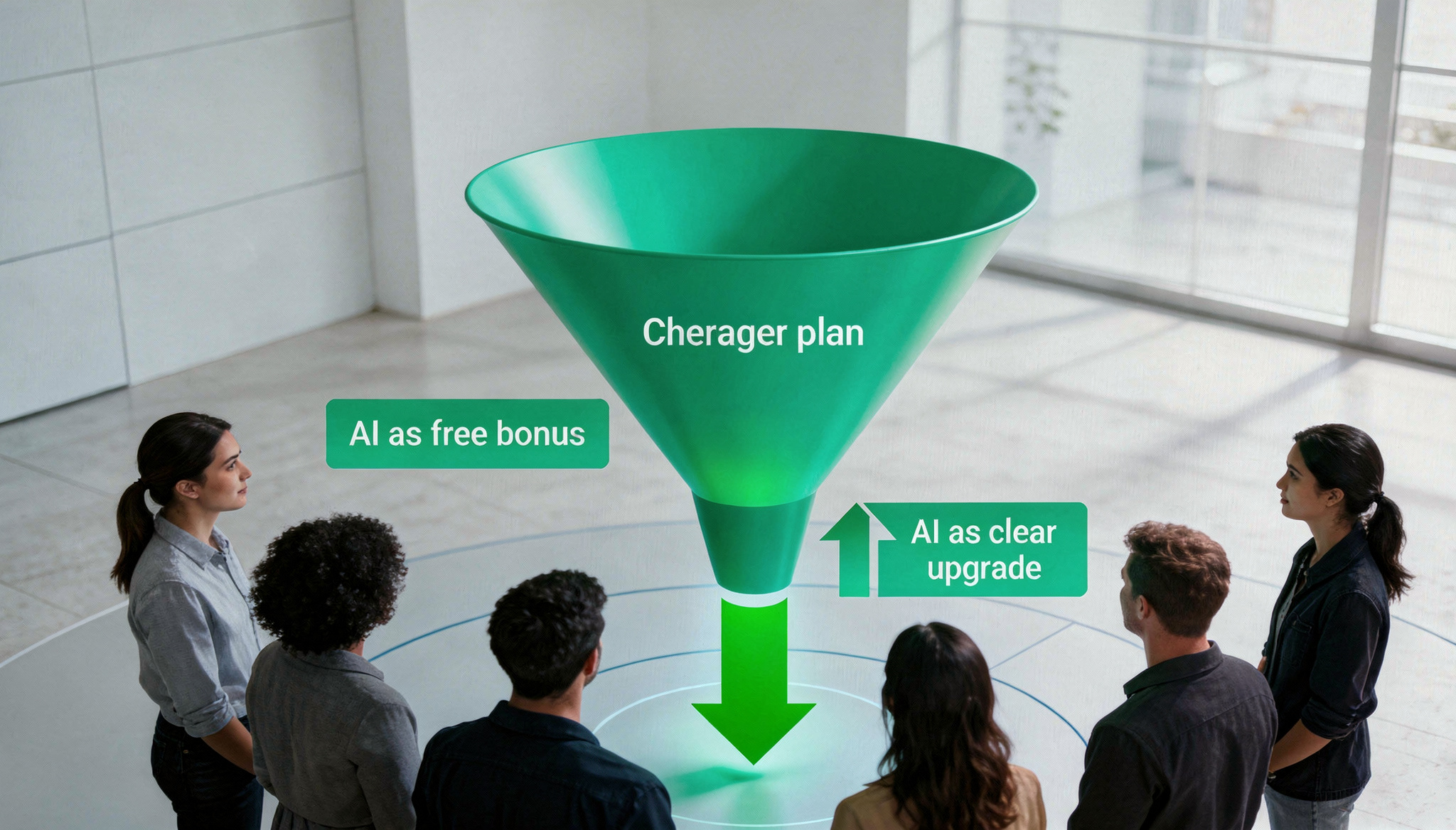
If they see it as a free bonus, a minor add-on, or something that should already be included, willingness to pay starts falling before the monetization strategy has even had a chance to work.
One common problem is simple price spacing. When plans sit too close together, customers do the math quickly and decide there is no real reason to move up. If the upgrade feels only slightly different from the current tier, the safer choice is to stay put.
That issue becomes even sharper with AI because many buyers are still learning how to value it. If the jump is unclear, they default to the cheaper plan.
Another is treating AI like a ‘free sweetener’. This is one of the easiest traps to fall into, especially when teams want fast adoption or feel pressure to show momentum.
But once AI is framed as something extra you get at no additional cost, customers start to see it as part of the baseline. That can make future monetization harder, especially when AI carries real compute and support costs.
The third issue is weaker value differentiation. Some companies bundle AI into plans without being clear about who it is for, what problem it solves, or why it belongs at a higher tier.
That leaves buyers staring at a pricing page full of labels, limits, and feature lists without a strong sense of what actually changes for them. And when that happens, AI starts to feel like decoration instead of a meaningful reason to upgrade.
Packaging gets more complex, but the offer doesn’t become more compelling.
There’s a reason why so many SaaS vendors have become more careful in this area. In 2025, 68% of SaaS vendors restricted AI to premium tiers, largely to protect perceived value and avoid collapsing the difference between plans.
This doesn’t mean every AI feature belongs behind the highest paywall, but once again, it shows that many teams have already learned the same lesson: once AI undermines the value of the core offer, pricing gets harder to defend.
Match AI Features to the Right Pricing Model
One reason AI monetization gets messy so quickly is that companies treat very different capabilities as if they belong under one pricing logic, but they don’t.
Hence, before deciding how to sell AI, it helps to sort features by the kind of value they create. That usually leads to a better fit between the product experience and the way customers are charged.
Category 1: productivity enhancers (copilot-style)
These are the features that help people move faster inside work they already do, such as:
- autocomplete,
- smart suggestions,
- summarization,
- assisted drafting.
Features like these improve speed and convenience, but the user still stays in control of the workflow.
That makes this category a natural fit for a premium add-on or mid-tier unlock. Customers can see the added value, but they are still paying for an improved version of the same workflow, not a fully automated outcome.
It helps explain why copilot-style AI add-ons were priced 30% to 110% above base per-seat cost in 2025. It also lines up with how copilots are commonly monetized across the market, often through seat-based or consumption-based pricing tied to productivity benefits.
Category 2: workflow automators
These features replace a multi-step manual process with a faster automated flow, such as report generation, anomaly detection, or smart routing. The value with them is tied more directly to work removed, time saved, or throughput gained.
This makes usage-based or outcome-based pricing a better fit.
When the AI is doing more of the actual work, charging by task, output, or result starts to make more sense. More than 30% of enterprise SaaS solutions incorporated outcome-based pricing by 2025.
Usage-based pricing also continues to gain momentum in SaaS because it aligns cost more closely with real consumption and gives customers more flexibility as their needs change.
Category 3: intelligence layers (predictive/agentic)
These are the AI capabilities that act more proactively: predictive recommendations, agentic features, and autonomous workflows that take action on the user’s behalf. They can create significant value, but they also bring more uncertainty around usage, cost, and pricing.
That’s why hybrid pricing tends to fit best here, with a base subscription combined with a usage or consumption metric. Mixed models have become the norm in AI software, with 92% of AI software companies now using them in some form.
How to Build AI Pricing Tiers That Encourage Upgrades
After choosing the pricing model, SaaS teams need to decide where AI belongs in their plans. That choice shapes whether customers see AI as a clear upgrade or another confusing layer on the pricing page.
To start, each plan needs to feel meaningfully different.
Buyers should be able to see:
- who a tier is for,
- what changes at that level,
- and why the higher price exists.
When AI is added into an existing plan without that separation, the offer gets harder to read. A cleaner structure is the “good-better-best-AI” strategy, where AI sits as a separate layer instead of being squeezed into a plan that was built for something else.

The Add-On approach: low risk, real learning
For many SaaS teams, an add-on gives customers a clear choice, keeps the base offer intact, and creates room to test willingness to pay before changing the entire pricing structure. Add-ons usually account for 10% to 15% of total revenue and remain one of the least risky ways to introduce new monetization paths.
They also give teams better data on adoption, usage, and where AI creates enough value to justify a larger packaging shift.
Grandfathering existing customers
Pricing changes tend to create the most friction with customers who already know your product and plans. That’s why an appropriate transition is so important. A good approach is to lock-in legacy pricing for a specific period, then move customers to the new model at renewal or expansion.
This protects trust while giving the business time to roll out AI packaging more carefully. In addition to that, it creates a cleaner path for testing new pricing on new customers and upsell opportunities first.
Make AI Strengthen Your Core Product
It’s true that AI can easily take over the story if a company lets it. When that happens, the core product underneath can start to look less valuable.
For SaaS companies, that’s a real risk. It’s also why the platform your customers already trust should remain at the center of the experience, even as AI features are added.
To do this, businesses need to ensure that their strongest AI features work quietly. They should help users move faster, remove repetitive steps, and improve the product without forcing customers to change how they work.
AI features can spread quickly across the market. However, what doesn’t spread as easily is the data inside your product, your understanding of the customer, and the way your software fits a specific industry or workflow.
For instance, a product built around real customer history, industry needs, and day-to-day workflows carries more weight than a generic AI tool with no business context. This is why companies with stronger data and deeper market knowledge are in a better position to stay valuable as AI becomes more common.
The Metrics That Tell You If Your AI Monetization Is Working
It’s possible for AI adoption to look impressive without actually improving the business. A feature can get clicks, trial usage, and plenty of internal attention while doing very little for revenue, retention, or margin. That’s why adoption alone is generally a weak signal.
A better test is whether AI is helping the business grow in a healthier way.
Start with AI attach rate. This shows how many customers are actually paying for AI-enabled plans or add-ons. It gives a clearer picture of monetization than feature usage on its own.
Then look at Net Revenue Retention. If AI is doing its job well, customers on AI plans should expand more strongly and stay longer than those who aren’t using them. NRR is one of the clearest ways to see whether new monetization is supporting long-term account growth.
Plan upgrade velocity is also crucial. How long does it take for a free or base user to move into an AI tier? If that journey is too slow, the issue may not be demand, but rather weak positioning, poor onboarding, or an offer that still feels optional rather than valuable.
Then there is gross margin by AI plan, which cannot be ignored. AI carries real delivery costs, and that changes the economics.
AI products often operate closer to 50% to 60% gross margins, compared with 80% to 90% for traditional SaaS. So if your AI revenue is growing while margins are quietly shrinking, the model needs attention.

Final Thoughts
AI doesn’t have to pull value away from the product that built your business. With the right pricing structure, it can strengthen that product, open new revenue paths, and give customers a clearer reason to grow with you.
The SaaS companies pulling ahead in 2026 are treating AI monetization as a strategic decision. They’re making deliberate choices about value, packaging, and pricing instead of turning AI into a loose collection of features.
Ready to rethink how you package and sell AI features? Let’s talk about what the right monetization model could look like for your product.