


The brands growing fastest right now aren’t the ones with the biggest budgets. They’re the ones who understood what actually changed, then rebuilt their strategy around it.
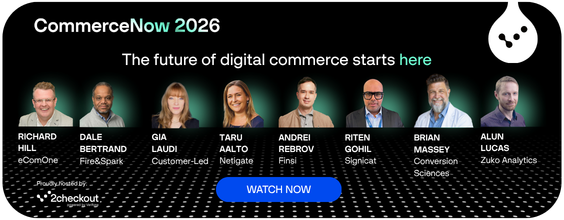
That was the thread running through CommerceNow’26, 2Checkout’s tenth annual digital commerce event. Across eight sessions, one pattern kept surfacing. AI is no longer a feature bolted onto commerce. It has become the layer customers use to discover products, weigh their options, and decide whether to trust you at checkout. Every speaker, in a different way, was answering the same question: what do you do differently now?
Bonus read: What CEOs and eCommerce Leaders Think About AI in 2026 | 2Checkout Blog

The good news is that none of this asks you to throw out what already works. The harder part is that a thin layer of new work now decides whether an assistant, or a shopper, chooses you over a competitor. Here’s what stood out.
AI is now the front door to your store
Search stopped being a list of blue links. Today a customer asks an assistant like ChatGPT, Claude, or Perplexity for a recommendation, and it names two or three brands. One of them may not be yours. Adobe’s data points to roughly a fourfold year-on-year jump in AI-referred retail traffic, and clickstream analysis suggests most searches now end without anyone clicking through to a site at all.
The mechanics matter. An assistant doesn’t run one search. It fans a broad question out into many related ones, then assembles a single answer from the sources it trusts. It isn’t ranking pages. It’s choosing brands. Richard Hill, who runs the eCommerce agency eCom One, keeps correcting his own vocabulary on this point: you’re no longer climbing a list, you’re being chosen.
Dale Bertrand, of the SEO agency Fire & Spark, puts the stakes plainly. If an assistant can’t describe what your brand does, who you serve, and why you’re trustworthy, then you don’t exist in the buying process.
So what should you do?
- Answer the questions buyers actually ask. Put the answer in the first sentence, then use question-style headings, comparison tables, and short Q&A blocks. Vague copy gets skipped.
- Own a topic, not a keyword. Buying guides and well-structured “top 10” lists built around a category consistently earn citations.
- Earn mentions, not just backlinks. Reviews, Reddit, YouTube, and comparison sites all shape what AI says about you, and a mention counts even without a link.
- Audit your reputation. Ask an assistant what it says about your brand. One technically flawless store lost roughly half its traffic because AI had learned that customers weren’t receiving their orders. The buying experience is now a discovery asset.
Recommended: Watch our latest session on how Agentic AI is redefining eCommerce

Understanding your customer is the only advantage left
When products are easy to build and campaigns are cheap to launch, most growth problems turn out to be strategy problems in disguise. And most strategy problems come from not really knowing your customer. That was the through-line of Gia Laudi‘s session (co-author of Forget the Funnel). In a saturated market, only “painkillers” cut through: products positioned around a problem so specific that buyers can’t ignore it.
The proof was a team that reframed itself from “inspection software” to “growth infrastructure for operators scaling faster than they can confidently manage.” Same traffic, nearly double the signups.
The other half of the work is closing the gap between what happened and why. As Taru Aalto, Chief Customer Officer at Netigate, put it, teams can see conversion dropping or churn creeping up, but they rarely know the cause. Joining operational data (the what) with experience data (the why) into a repeatable signal-to-action loop is what turns feedback into revenue. AI now makes it practical to read reviews, tickets, and surveys at scale, prioritized by business impact rather than volume.
So what should you do?
- Add one open text field to your signup flow: “What led you here today?” Then watch which answers become your happiest customers.
- Prioritize fixes by impact and strategic fit, not by how often something gets mentioned.
- Start small. Pick one journey stage, a few signals, and one clear owner, then expand once the results are stable.
Bonus read: AI‑Powered Shopping Agents And How You Should Prepare
The checkout is a trust test
Three sessions converged on the same moment: the point of purchase.
Fraud is the first pressure. Riten Gohil, of Signicat, described how AI has lowered the cost of attacking you. Synthetic identities, deepfakes that pass liveness checks, and bots that mimic genuine buyers at scale are now within easy reach. No single control holds up anymore. The stronger approach layers behavioral signals, device and location data, NFC-based document verification (with fraud rates under 1%), and the emerging EU identity wallets. The brands that win put trust at the heart of checkout instead of treating it as an afterthought.
Recommended: Discover 2Checkout’s comprehensive fraud management solutions.
Trust also breaks in quieter ways. Alun Lucas, of Zuko Analytics, noted that close to The usual culprits are familiar: surprise shipping costs, forced account creation, a prominent discount-code box that sends buyers off hunting for a code they don’t have, unexplained phone-number fields, and fussy password rules. The fix is almost always transparency. Show the full cost early, offer a guest checkout, and explain why you ask for each piece of information.
And the promise an ad makes has to be kept by the page it lands on. Brian Massey, of Conversion Sciences, showed that when the offer, headline, product, price, and tone all carry through from ad to landing page, conversions hold. Tightening that alignment alone can lift results by 15 to 20%.
So what should you do?
- Treat fraud defense and customer friction as one problem. Clear the path for good customers, and add friction only where the risk is genuine.
- Show total cost up front, and let people buy as guests.
- Match every ad to a page that repeats its offer and its hook.
AI changes the economics of execution
The ceiling on experimentation is higher than it has ever been. Yet most teams still get average results, because they treat AI like a vending machine. Andrei Rebrov, co-founder of Finsi, offered a better mental model: treat it like a new hire. Give it context (your business, what’s worked, what hasn’t), skills (written instructions for how to evaluate a campaign or a funnel), and a schedule, so it works proactively rather than only when prompted.
His cautionary tale was blunt. One campaign sent 14,000 emails and produced two orders, because the message spoke to product users when the recipients were gift buyers. Better tools can’t rescue the wrong strategy.
So what should you do?
- Start with one small, repeatable task, like a daily performance summary. Prove the time it saves, then expand.
- Keep a human in the loop, and don’t let AI do your math. Hardwire the metrics, and let AI explain them.
- Iterate constantly. Set-and-forget fails when platforms and audiences shift every few months.
Bringing it together
Across all eight sessions, the same idea held. AI has raised the floor. Anyone can build a store, launch a campaign, or spend on ads in an afternoon, which makes the old advantages of budget, speed, and volume easy to copy. What’s left is judgment: understanding your customer more deeply than your competitors do, earning trust at the moment of purchase, and becoming the brand an assistant chooses to recommend. That’s a shift worth getting right.
Want the full playbooks behind these takeaways?
Every session is available to watch on demand. Head to Commerce Now ’26 event page to see the discovery-to-checkout journey in full.