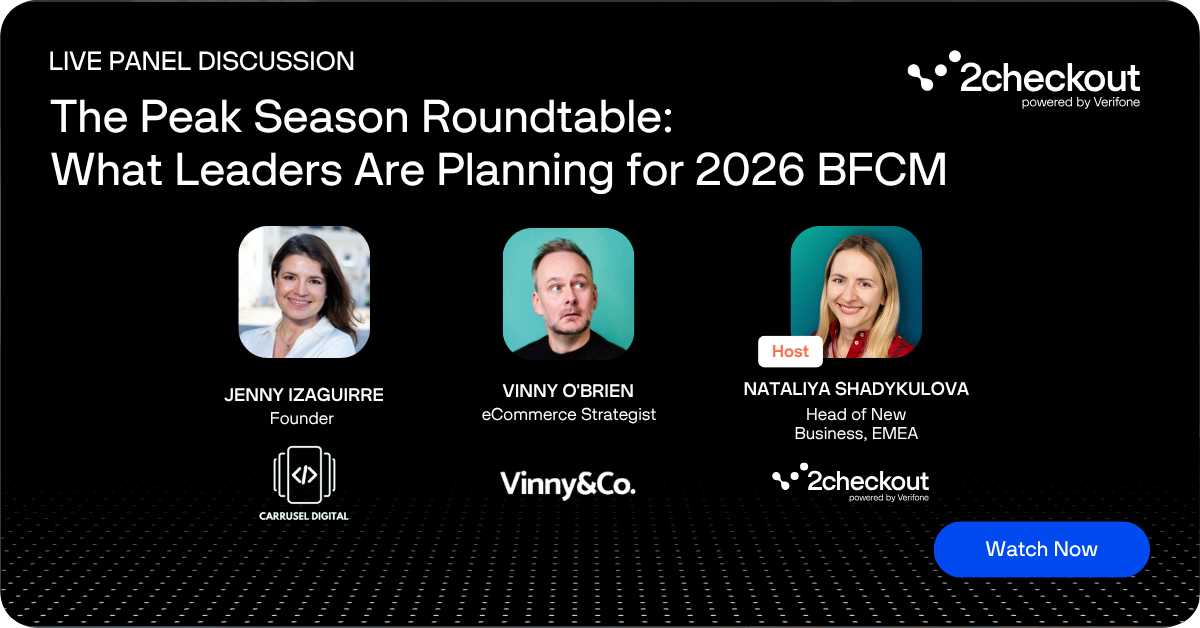
For years, peak season meant bracing for one frantic weekend. That is fading. Black Friday and Cyber Monday are still the spike, but the real work now runs for weeks on either side, and for subscription and digital brands it stretches into January. The teams that plan for a season, not a 72-hour sprint, are the ones protecting their margins.
That was the backdrop for our peak season roundtable, hosted by Nataliya Shadykulova of 2Checkout with Jenny Izaguirre, founder of Carrusel Digital and a former Shopify leader, and Vinny O’Brien, eCommerce strategist and founder of Vinny&Co. Here are the headlines. The reasoning, examples and numbers are in the recording.
Stop planning for a weekend, plan for a season
Black Friday and Cyber Monday are no longer an event, they are the loudest moment in a season that opens weeks earlier and runs past Cyber Monday. Demand builds through November, spikes over the weekend, and returns in January. The panel’s advice: spread the effort across smaller moments, plan the weeks after, and keep an eye on the next quarter. Some brands are even dropping the BFCM label for a calmer, longer holiday push.
Lock the tech now, keep the offer flexible
By five weeks out, payments and fraud controls, pricing and promotions should already be built and tested for peak volume. Only your promotion strategy stays flexible, and even that has a deadline. Then plan for what you can’t predict. The panel covered contingency planning, from fallback payment methods to the fintech outage that hit this year. Be ready to do something at peak that you didn’t plan three months ago.
Retire the blank-check discount
Stamping one big percentage across the store no longer works. One figure shared: for Irish retailers, every €100 spent returned roughly €4.30 in net profit about four years ago, and closer to €2.60 in 2026. So ask where to discount, where to hold full price, and where you could even raise it. For SaaS, Jenny made the case for adding value over cutting price, and for avoiding deals that look great on Cyber Monday and trigger churn at renewal.
Win peak season in the off-season
If you sell SaaS or digital products, the weekend is not where you win. You win in the months before and after, onboarding and educating the customers you already have. Jenny noted that many Shopify adopters arrive right after Cyber Monday and again in January, so chasing new customers at peak is the most expensive bet. Vinny pointed to Amazon Prime, which keeps raising its price and keeps its customers because it proves value all year. Their idea: several small moments of delight a year instead of one deep discount.
Spend where you can actually win
Acquisition costs climb every year from September into the peak. One contrarian response: pull back on paid when you can’t outbid bigger players, and redirect that budget into retention, education and the middle of the funnel. Settle one question before you spend a cent: are you chasing return on ad spend, or market share across the season?

Out-human your competitors
The thing customers said they want most is a human. Put a real person in front of your top accounts, and make support reachable when an account locks or a platform goes dark on the busiest day. Automation should make life easier: bots that handle a simple job are fine, bots that trap people are not. Start by making your five most important customer journeys genuinely smooth.
Stress-test for the day something breaks
Do the math now. If you double expected orders, can fulfillment, staffing and suppliers keep up all season, and what do you do if a day finishes 10, 20 or 30% under target? The panel also shared a simple daily ritual, a returns approach that turns a refund into a reason to come back, and a reminder to settle new EU rules on AI content and agent-driven purchases this week, not in December.
Frequently asked questions
Is BFCM still just one weekend?
Not in practice. Demand builds for weeks beforehand and continues into January, especially for subscription and digital brands.
When should BFCM preparations be finished?
By roughly five weeks out, payments, fraud, pricing and promotions should be built and tested. The promotion strategy is the main lever still worth adjusting late.
Should SaaS and subscription companies run Black Friday and Cyber Monday discounts?
Not automatically. With tighter margins, a blanket discount can lose money and spark churn at renewal. Many digital brands do better by adding value or tiering their offers.
How is AI changing BFCM in 2026?
Expect more agent-driven purchases, higher conversion on AI channels, and “my agent bought this” returns. A simple first step: ask an AI assistant about your brand and see whether you show up.
Revenue is up, but did BFCM actually work?
Not always. Weigh your true cost to sell and ship, your ad spend in the priciest window of the year, and your retention after the season ends.
Want the full playbook, examples and all?
This recap covers the headlines. In the on-demand recording, Jenny and Vinny work through the tactics, the numbers and the mistakes to avoid before BFCM 2026.
Watch the peak season roundtable on demand