

Brazil is one of the fastest-growing eCommerce markets in the world. It is also one of the easiest to get wrong.
Businesses that localize payments, pricing, taxes, and compliance can access more than and a market where online shopping revenue hit 235.5 billion Brazilian reals in 2025, up 15.3% year-on-year. By skipping that preparation, you risk running into failed payments, abandoned carts, and regulatory problems that are entirely avoidable.
The good news is that Brazil’s rules can be predictable. Payment preferences are well-documented. Tax obligations are changing, but the timeline is public. Data privacy enforcement has finally picked up, and the expectations consumers have about language, currency, and checkout are clear.
This guide covers the key things that have changed since Brazil was first on most international sellers’ radar, what still holds true, and what every business needs to get right before going live.
Quick checklist: Brazil readiness at a glance
Before diving into the details, here are some quick takeaways:
- Payments: You should be able to accept Pix (now the dominant instant payment method), Boleto Bancario, and local credit cards with installment options.
- Currency: Display prices in Brazilian Reals (BRL) to improve conversion rates and help shoppers avoid currency conversion costs.
- Checkout: Make sure it’s localized in Brazilian Portuguese, with CPF/CNPJ tax ID fields, optimized for mobile.
- Subscriptions: If applicable, offer both monthly and annual billing options to appeal to different buyer segments.
- LGPD compliance: Ensure privacy policy, consent flows, and data processing meet Brazilian law.
- Tax and legal: Engage Brazilian legal and tax counsel before scaling. The CBS/IBS reform is underway.
- Localization: Use Brazilian Portuguese, not European Portuguese. Adapt messaging by region where possible.
Bonus: Check out this guide on how to start an eCommerce business.
Brazil’s digital market: scale, mobile, and a maturing consumer base
Brazil is home to , and the population’s device habits matter as much as the numbers. Some 88.9% of the population owns a mobile phone, and 98.8% of internet users access the web primarily via smartphones. The country’s digital consumers are mobile-first by habit, not just by circumstance.
That has translated directly into how people shop. As of 2025, mobile accounts for 55.5% of online purchases with desktop responsible for the remaining 44.5%. The mobile eCommerce market is forecast to reach $51.5 billion USD by end of the year, more than double the desktop segment at $26.5 billion USD. Any merchant entering Brazil without a mobile-optimized checkout is starting at a disadvantage.
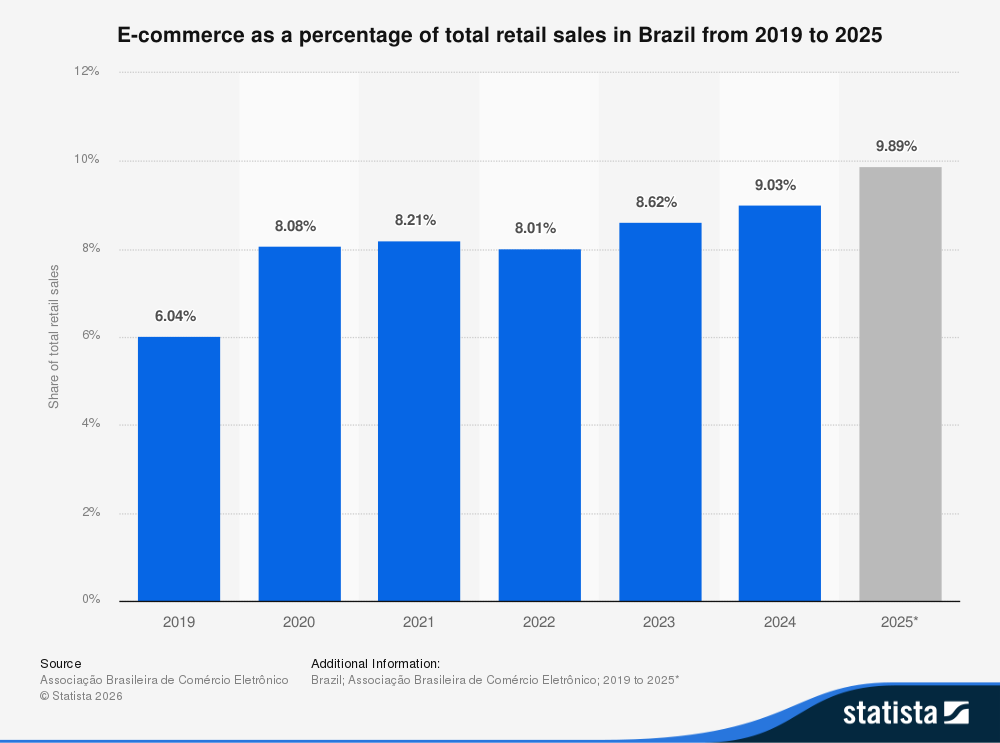
Around The number of eCommerce users is projected to reach 178 million by 2029, adding tens of millions of new digital shoppers over the coming years. Online sales now represent around 9% of total retail and that share is growing steadily.
Brazil’s digital shoppers also have a strong appetite for subscriptions and digital services. Video streaming is owned by at least one in two Brazilians, digital music subscriptions have strong adoption in Brazil, and SaaS startups consistently attract the largest share of Brazilian tech investment. For software and digital goods companies, this is a receptive, digitally native audience.
Brazil’s digital shoppers also have a strong appetite for subscriptions and digital services. Video streaming is owned by at least one in two Brazilians, digital music subscriptions have strong adoption in Brazil, and SaaS startups consistently attract the largest share of Brazilian tech investment. For software and digital goods companies, this is a receptive, digitally native audience.
Payments: what has changed and what hasn’t
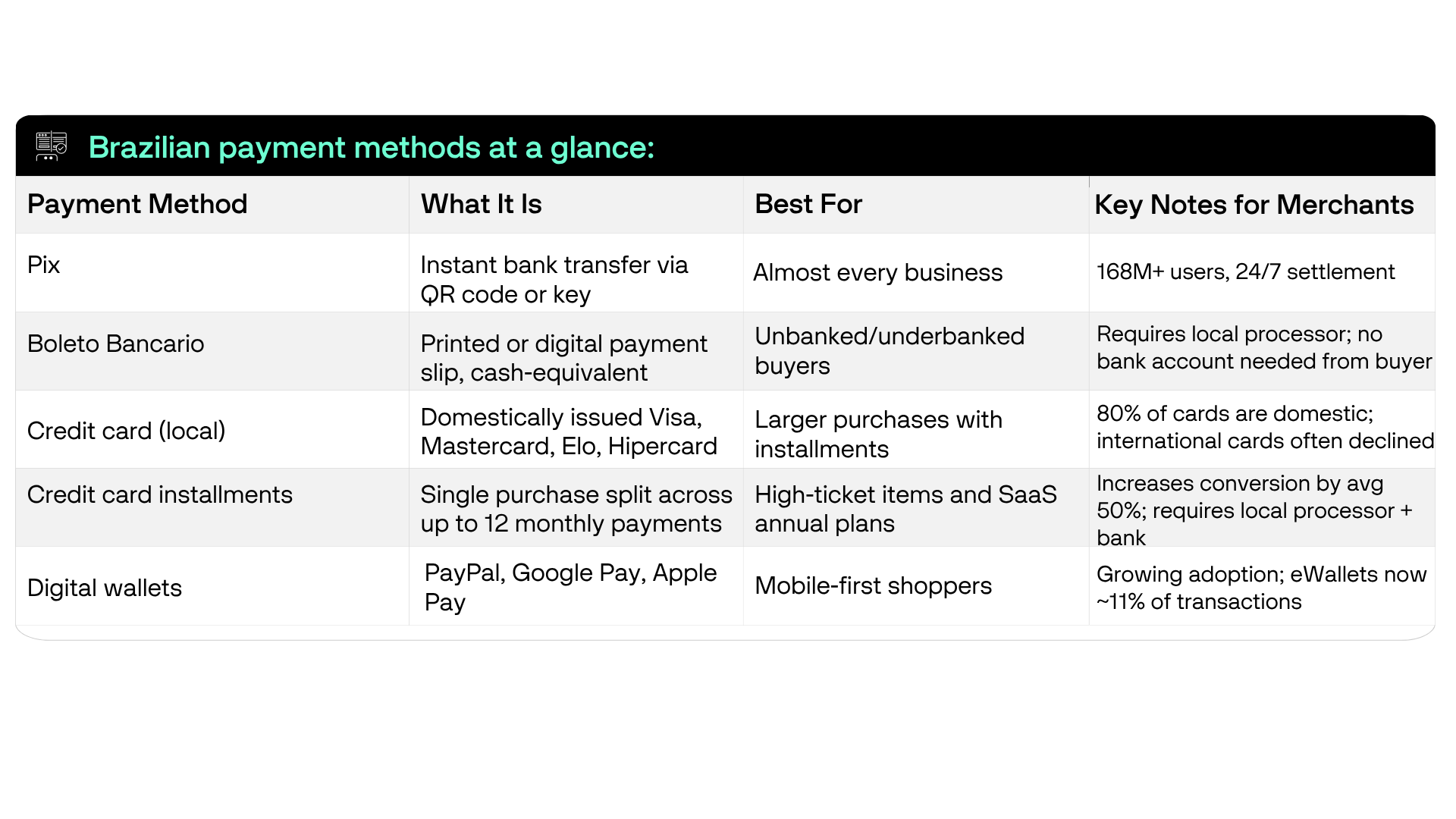
What makes Pix a game changer? In November 2020, Brazil’s Central Bank launched Pix, an instant payment system that processes transfers 24/7, in seconds. Six years later, it has fundamentally reshaped how Brazilians move money online.
Pix has grown to serve nearly 170 million registered users, essentially covering the entirety of Brazil’s internet-connected population. By 2024, it had surpassed traditional wire transfers in transaction volume and its adoption continues to rise.
Boleto Bancario, installments, and the Brazilian real
Pix is the new standard, but it does not make the traditional methods redundant. They still drive a substantial share of transactions and, more importantly, they reach segments of the population that Pix alone does not cover.
Source: 2Checkout platform data; Statista; Central Bank of Brazil
What is Boleto Bancario?
Boleto Bancario is the official payment method regulated by the Central Bank of Brazil and functions as a proxy for cash. The buyer receives a pre-filled slip that can be paid at any of the country’s roughly 48,000 ATMs, at bank branches, lottery agencies, or supermarkets, as well as via banking apps online. Cross-border merchants cannot offer it without partnering with a local payment processor.
Currency law: While international merchants can display prices in other currencies, offering prices in Brazilian Reals (BRL) is recommended. It improves conversion rates by reducing currency conversion costs and creating a more familiar checkout experience for Brazilian shoppers. Approximately 80% of cards used in Brazil are issued domestically, so accepting only internationally-issued cards as your primary checkout option will produce high decline rates.
Tax reform: what is changing and when
Brazil has historically ranked 184th out of 190 nations for tax complexity. The system is now being overhauled in the most significant fiscal reform in decades, which consolidates five existing indirect taxes into two new instruments.
The five taxes being replaced:
- PIS (federal contribution on revenue)
- COFINS (another federal contribution on revenue)
- ICMS (state-level goods and services circulation tax)
- ISS (municipal services tax)
- IPI (federal tax on manufactured products)
The two new instruments:
- CBS (Contribuicao sobre Bens e Servicos): federal, replacing PIS and COFINS
- IBS (Imposto sobre Bens e Servicos): sub-national, replacing ICMS and ISS
Reform timeline:
Year |
What Happens |
2026 |
Pilot period begins; CBS and IBS introduced at low rates alongside existing taxes |
2027 |
CBS fully replaces PIS and COFINS |
2029-2032 |
IBS progressively increases as ICMS and ISS are phased out |
2033 |
Full completion; new system operational across all levels of government |
For cross-border digital sellers, the direction is toward greater formalization of digital transactions. Brazil has no revenue threshold for tax registration: companies are technically required to register from their first sale in the country. Engaging qualified Brazilian legal or tax counsel before scaling is not optional.
LGPD: Data privacy enforcement is now real
Brazil’s Lei Geral de Protecao de Dados (LGPD), Law No. 13.709/2018, was modeled closely on the EU’s GDPR. It covers personal data processing across both public and private sectors, establishes the rights of data subjects, and defines the obligations of data controllers and processors.
The LGPD entered force in September 2020 and is enforced by the Autoridade Nacional de Protecao de Dados (ANPD). For the first few years, enforcement was limited. That changed in 2023 when the ANPD issued its first formal fine. By 2025, 76 formal enforcement proceedings had been opened. This is no longer a theoretical compliance risk.
What the LGPD covers for online sellers:
- Customer data collected through checkout flows or account registration
- Payment information or behavioral data processed on your platform
- Marketing communications sent to Brazilian contacts
- Analytics and tracking tools that capture personally identifiable information
Companies already compliant with GDPR will find the LGPD broadly familiar in structure. The key differences include the specific role of the ANPD, some variation in the legal bases for processing, and certain local requirements around data subject rights. A legal review of your current data practices for Brazilian operations is advisable before scaling.
Localization: language, regions, and the checkout experience
Brazilian Portuguese is not European Portuguese
Brazil speaks Portuguese, but Brazilian Portuguese has significant written and spoken differences from its European counterpart. These differences are immediately obvious to Brazilian readers, and a store localized with European Portuguese text will not feel native. Brazilians prefer stores that feel local and are quick to leave those that don’t.
Amazon, for example, maintains a fully separate Brazilian storefront with localized products, pricing, promotions, and payment methods. For merchants with multiple storefronts, dynamic cart templates that localize pricing in BRL and surface Brazilian Portuguese text based on browser settings are far more scalable than hardcoded fields.
Five regions, one country, different consumers
Brazil is divided into five distinct regions: North, Northeast, Center-West, Southeast, and South. Each has its own cultural characteristics, purchasing habits, and economic profile. The Sao Paulo metropolitan area accounts for a disproportionate share of digital commerce, but the Northeast and North are growing rapidly. Logistics timelines and infrastructure quality also vary significantly by region.
Treating Brazil as a single homogeneous market is a mistake many international sellers could easily make. Effective localization, particularly for promotions and product assortment, often needs to account for regional differences.
5 mistakes international sellers make in Brazil
These are the most common reasons well-prepared merchants still underperform in Brazil.
- Accepting only Visa and Mastercard
Around 80% of cards used in Brazil are issued domestically. Customers attempting to pay with domestic cards through international acquirers often encounter a common challenge in Brazil. Many Brazilian banks restrict domestically issued cards to local transactions, preventing them from being used with international acquirers. As a result, these payments may be declined even when the customer has sufficient funds and the card is otherwise valid.
- Pricing in USD
Displaying prices in any currency other than the Brazilian Real is illegal for local businesses based in Brazil and doing domestic transactions, under Brazilian consumer protection law. Beyond the legal risk, it immediately signals to shoppers that the store is not set up for them. Trust disappears fast.
- Using European Portuguese
European and Brazilian Portuguese sound and read differently. The vocabulary differences, spelling conventions, and phrasing diverge enough that Brazilian readers notice immediately. Using the wrong variant communicates that no real localization effort was made.
- Ignoring LGPD
The ANPD has now issued fines and opened 76+ formal proceedings. LGPD is not a future problem. Any company processing data from Brazilian residents, regardless of where the company is based, is in scope. The exposure is real and it applies to marketing tools, analytics, and checkout flows, not just core databases.
- Assuming logistics work like the US or Europe
Is Brazil the right market for your business right now?
Brazil rewards businesses that are ready for it, and exposes those that are not.
Businesses that cannot localize their checkout, do not have access to local payment infrastructure, or are not positioned to meet LGPD requirements will see the results in their metrics.
The market is well-suited for software, SaaS, digital goods, media, and subscription businesses. These categories avoid the customs complexity entirely, align with Brazilian consumers’ well-documented appetite for subscriptions, and benefit from the fact that Pix and digital payments infrastructure is now excellent.
2Checkout has the infrastructure, local payment connections, and global commerce expertise to help you enter Brazil correctly. From Pix and Boleto to subscription billing, tax management, and localized checkout flows, the platform handles the complexity so you can focus on growing your business.
Ready to sell in Brazil? Talk to a 2Checkout eCommerce specialist today.